

















We’ve all been told to “strengthen the core,” but Pilates actually makes good on that promise without demanding you fold yourself into circus-level shapes. It’s low-impact, big on control, and surprisingly sneaky at working muscles you didn’t realise you had.
Beyond the vanity of a flatter stomach, a stronger core helps with posture, balance, and even everyday chores like lugging the shopping bags in from the boot of the car.
The best bit? You don’t need fancy kit. A mat, a bit of space, and willingness will do.
Also Read: How Yoga, Strength Training and Everyday Movement Heal the Mind
The classics that never go out of fashion
First up is The Hundred, the Pilates warm-up with cult status.
You lie on your back, lift your legs into tabletop or stretch them long, then pump your arms up and down like you’re desperately hailing a cab. The aim is to reach 100 beats while breathing in and out in sets of five. It’s tough but oddly satisfying, and it sets the tone for the rest of your workout.
You lie on your back, lift your legs into tabletop or stretch them long, then pump your arms up and down like you’re desperately hailing a cab.
Next, the Roll Up. Unlike a sit-up, which often ends in a graceless flop, this move is all about control. Start flat, arms overhead, then peel your spine off the floor one vertebra at a time until you’re reaching for your toes. Imagine unrolling yourself like a Swiss roll in reverse. Roll back down with the same control. Done properly, it gives your abs a deep workout while stretching your spine.
Moves that test control and co-ordination
Enter the deceptively tricky Toe Taps. Lie on your back, legs bent at a neat 90 degrees, feet hovering. One toe lowers to the mat, taps lightly, then returns. Alternate sides. The trick? Keep your lower back glued to the floor. It’s small, controlled, and strangely addictive once you fall into the rhythm.
It’s small, controlled, and strangely addictive once you fall into the rhythm.
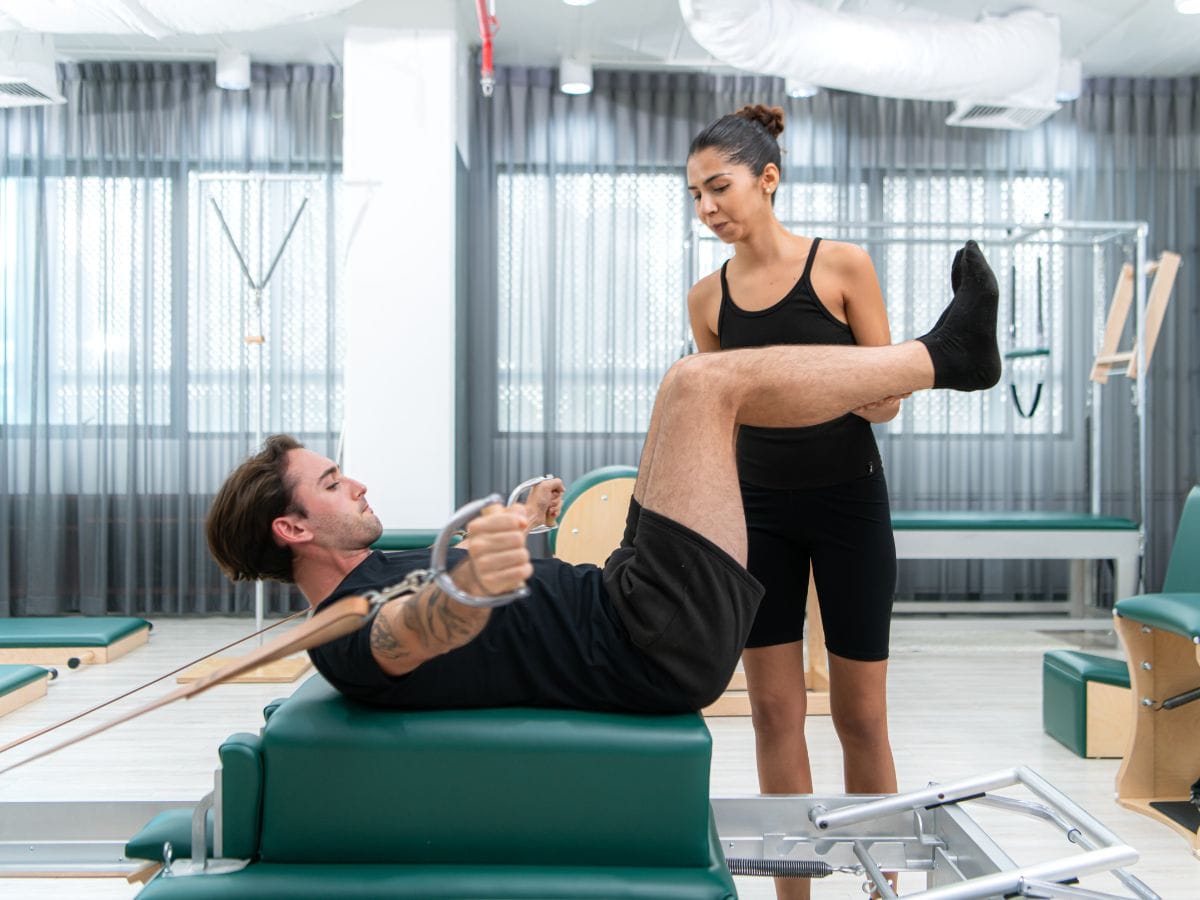
Then there are Leg Circles. One leg reaches to the ceiling while the other stays grounded. You draw circles in the air, starting small before daring to go wider. Keep your hips still—think of your pelvis as a tray of drinks you simply mustn’t spill. It works the hips and lower abs, but it also tests whether you can move one part of your body without the rest joining in. Spoiler: it’s harder than it sounds.
Adding a twist for the obliques
No core routine is complete without tackling the sides, and that’s where the Side Plank Twist comes in. Begin in a side plank, either on your hand or forearm, then sweep your top arm under your body before opening it back up to the ceiling. It’s basically Pilates’ way of saying, “Let’s see how good your balance really is.” Your obliques (those waist muscles that don’t get much limelight) will definitely pipe up here.
And then, the Double-Leg Stretch is a proper finale. Start on your back, hugging your knees in. Extend arms and legs out at the same time, arms overhead, legs long at roughly a 45-degree angle, then circle them back to the starting point. It looks graceful when done well, but it feels like a core-on-fire situation when you’re in the middle of it. The co-ordination required means your brain gets a workout, too.
How to make it stick
Here’s the thing: these moves work, but only if you turn up for them. Two or three sessions a week are enough to notice your posture improving and your mind feeling steadier. Keep the movements slow and controlled. Pilates is less about bashing through reps and more about precision. If you’re new, start with fewer repetitions and build up. If you’ve been around the block, add more sets or hold the poses for longer.
Pilates is less about bashing through reps and more about precision. If you’re new, start with fewer repetitions and build up.
And yes, you might feel daft flapping your arms in The Hundred or wobbling through a Side Plank Twist, but that’s part of the charm. The payoff is a stronger, more stable core that supports you in everything from sport to sitting at your desk without slumping. Plus, next time someone groans about sit-ups, you can smugly say, “Oh, I just do Pilates.”
This content is for general information only and not a substitute for professional advice. Please check with a healthcare provider before making changes to your fitness or diet.