


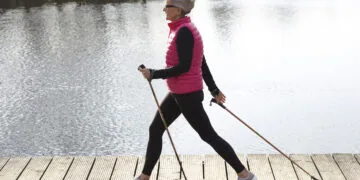






















































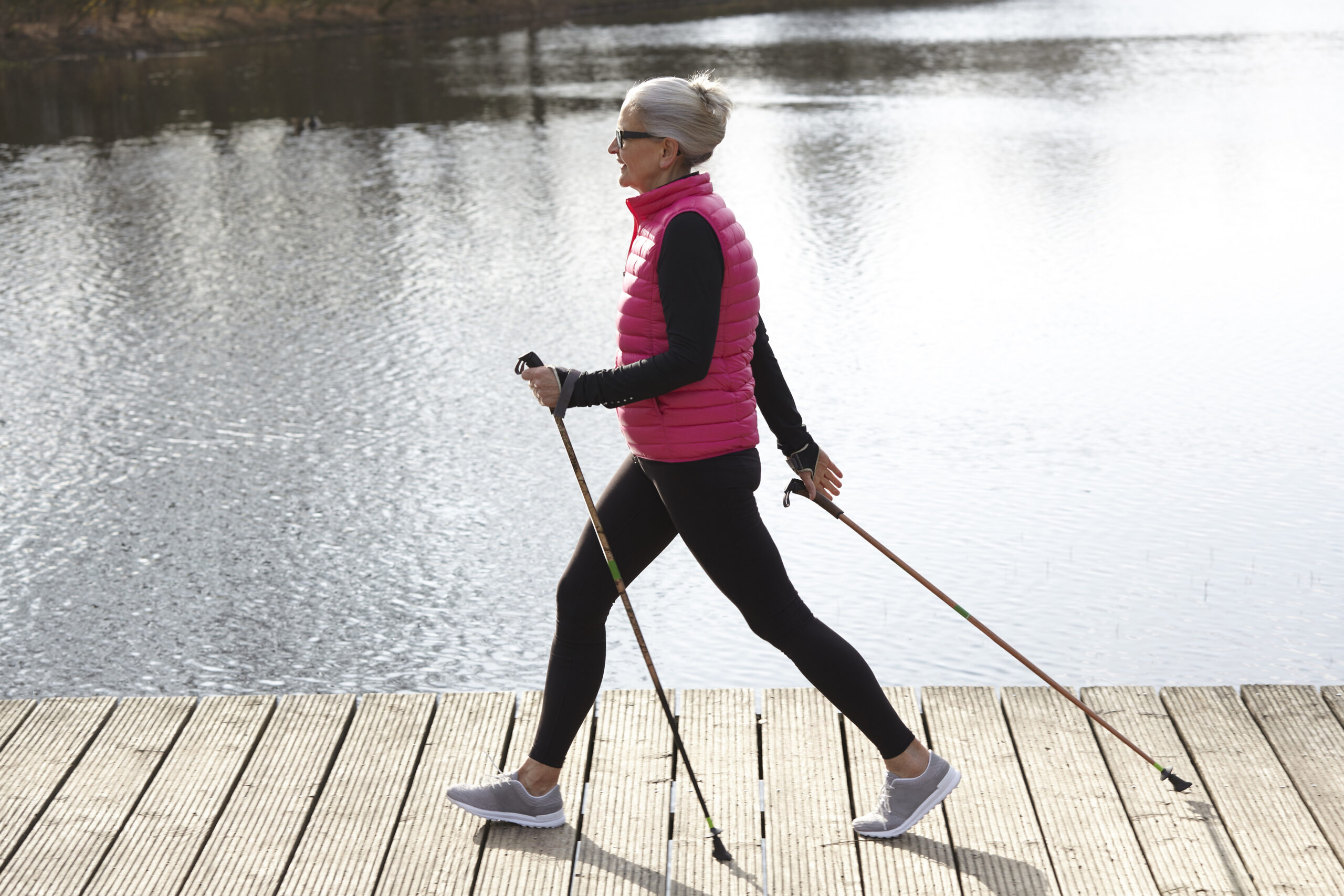
Picture a typical walk. Your legs do most of the work. Your arms swing along for the ride like background actors who never get a speaking role. Now picture a walk where your arms suddenly get promoted to co-stars. They push, drive, and power every step forward. The result feels less like a casual stroll and more like your whole body has agreed to join the meeting. That, in a nutshell, is Nordic walking.
At first glance, it can look a little funny. Two walking poles, no snow, and people striding along as if they took a wrong turn on their way to a cross-country skiing competition. Yet beneath the quirky first impression lies one of the most surprisingly effective forms of exercise around.
The workout hiding in plain sight
One reason Nordic walking tends to surprise people is that it disguises itself as something easy. Walking has a reputation problem. Mention it as exercise and many people picture a leisurely lap round the shopping centre or a slow wander through the neighbourhood while deciding what to cook for dinner. Useful? Sure. Exciting? Not exactly.
Also read: Brisk Walks, Big Gains: Why Japanese Interval Walking Works
Nordic walking changes the equation. The moment you plant the poles and actively push against the ground, your upper body joins the party. Your shoulders, arms, chest, upper back and core all become part of the movement. Suddenly, the humble walk starts behaving like a much bigger workout. It feels a bit like discovering that the quiet character in a movie was secretly carrying the entire plot.
Nordic walking changes the equation. The moment you plant the poles and actively push against the ground, your upper body joins the party. Your shoulders, arms, chest, upper back and core all become part of the movement.
You may notice your heart rate climbing faster than it does during an ordinary walk. You may also find yourself covering more ground without feeling as beaten up as you would after jogging. That’s part of the appeal. The effort spreads across more muscles, so no single area has to shoulder the entire burden. Instead of your legs doing all the heavy lifting, your body starts operating like a rowing crew. Everyone grabs an oar.
The anti-gym gym
Many people chase the dream of a full-body workout. That’s why gyms are packed with machines targeting every imaginable muscle group. Leg press for the legs. Rowing machine for the back. Chest press for the chest. Cable machine for everything else. Nordic walking takes a different approach. Rather than isolating muscles, it asks them to work together.
Think about how everyday life actually works. Carrying groceries, climbing stairs, hauling luggage through an airport, chasing after a runaway trolley in a car park. These activities rarely involve a single muscle. They’re team sports.
Nordic walking mirrors that reality. As your arms drive the poles backward, your torso stabilises. Your shoulders stay engaged. Your hips rotate naturally. Your legs keep propelling you forward. It becomes a coordinated chain reaction that travels from head to toe.
The secret ingredient is momentum
There is another reason Nordic walking stands out, and it has less to do with muscles than movement itself. Most exercise struggles against human psychology. We know we should do it. We know we’ll feel better afterwards. Yet convincing ourselves to start can feel like trying to negotiate a peace treaty with a stubborn cat.
Nordic walking has an unusual advantage. The poles create momentum. Once you establish a rhythm, your body naturally wants to keep moving. Each pole plant helps propel the next step. Each step encourages the next pole swing. It becomes a gentle mechanical loop.
You can see this in parks and walking paths. People often begin cautiously, almost self-conscious about the poles. Twenty minutes later, they’re striding along with the confidence of someone marching towards an important quest. No dragons await at the end, unfortunately. Usually just a water bottle and perhaps a snack. Still, the feeling matters.
Twenty minutes later, they’re striding along with the confidence of someone marching towards an important quest. No dragons await at the end, unfortunately.
Exercise habits often survive or fail based on enjoyment. If an activity feels like punishment, most people eventually abandon it. Nordic walking manages to occupy a sweet spot. Challenging enough to raise your heart rate. Comfortable enough that many people actually look forward to doing it. That combination can be surprisingly rare.
A different way to think about fitness
Perhaps the most interesting thing about Nordic walking is that it challenges a common assumption about exercise. Somewhere along the way, many of us learned that a serious workout has to happen indoors.
Bright lights. Machines. Mirrors. The soundtrack of weights clanking in the background. Nordic walking quietly argues otherwise. It suggests that fitness can happen on a tree-lined path. Along a coastal road. Through a neighbourhood waking up for the day. It turns ordinary places into training grounds.
Surprisingly close to the whole package
No single exercise can truly do everything. Yet Nordic walking comes surprisingly close to offering a little bit of everything. Cardio challenge. Upper-body engagement. Lower-body endurance. Core involvement. Fresh air as a bonus feature.
Not bad for something that looks, at first glance, like a regular walk carrying a couple of extra accessories. Sometimes the most effective fitness tools hide in plain sight. Nordic walking may be one of them. It takes a movement we’ve known since childhood and gives it a clever upgrade. Same road. Same body. Just a few poles, a little extra push, and suddenly your walk starts pulling double duty.