


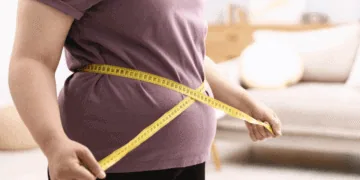
















































Everyone tracking weight loss on an injection has the same tool sitting in the bathroom, and it’s the wrong one for the job it’s being asked to do. A scale tells you total weight. It has no idea whether what you lost this week was fat or muscle.
If you’re wondering how to measure muscle loss at home without booking a scan or buying equipment, there’s a simple test that gives you a far better clue than the number under your feet, and it takes half a minute.
Body Composition Vs Scale Weight
This is the distinction the scale can’t make. Two people can weigh exactly the same and have completely different bodies underneath that number, one carrying more muscle, one carrying more fat. The scale doesn’t differentiate between muscle, fat or water weight, which means the same drop on the display could mean very different things depending on what’s actually coming off. Someone losing mostly fat and someone losing a worrying share of muscle can show up as identical numbers on the same morning.
That’s the whole problem with using weight alone to judge how weight loss is going, medicine or no medicine. The number moves, but it doesn’t tell you what moved.
Why Function Is A Better Clue Than Weight
You don’t need a DEXA scan to get a useful signal here. Muscle isn’t just about how you look, it’s about what your legs can actually do, and that’s something you can test yourself with nothing but a chair.
Also read: Want Sustainable Weight Loss? Try These 3 Exercises
The Chair Stand Test 30 Seconds Takes
This is a genuine clinical tool, not an invented fitness challenge. It’s used by physiotherapists and researchers specifically to assess lower body strength and endurance, and it takes exactly as long as the name suggests.
Here’s how to do it. Sit in the middle of a sturdy chair with no arms, feet flat on the floor, shoulder-width apart. Cross your arms over your chest. On go, stand all the way up, then sit all the way back down, and repeat for 30 seconds, counting each full stand. No pushing off with your hands. No half stands.
The number itself matters less than the trend. What you’re really doing is creating a baseline you can compare yourself against every few weeks, and the research behind this test suggests a change of two or more repetitions is a genuinely meaningful shift, not just noise from an off day.
What The Result Actually Tells You
If your number holds steady or climbs over the weeks you’re losing weight, that’s a good sign your legs are keeping their strength even as the scale moves, which points towards fat loss doing most of the work. If your number drops noticeably over the same stretch, particularly if it happens alongside rapid weight loss, that’s worth paying attention to. It doesn’t diagnose anything on its own, but it’s a far more useful early signal than watching the scale and hoping for the best.
This is really the practical answer to how to measure muscle loss at home. You’re not trying to get a lab-grade number. You’re trying to catch a trend early enough to do something about it, mainly through the protein and resistance training habits.
Building It Into A Routine
The test only works as a comparison, so consistency matters more than the exact number you get on day one. Do it at roughly the same time of day, same chair, same way of crossing your arms, and repeat it every two to four weeks rather than daily. Write the number down somewhere you’ll actually see again. A note in your phone works fine.
Do it at roughly the same time of day, same chair, same way of crossing your arms, and repeat it every two to four weeks rather than daily.
Pair it with how your clothes fit and how you feel doing everyday things like stairs or carrying shopping, and you’ve got a rough but genuinely useful picture of what’s happening beneath the number on the scale, without needing to book anything or buy anything.
Where This Leaves You
Body composition vs scale weight is the whole point of this test. The scale can tell you that something changed. It can’t tell you what. Thirty seconds on a chair, tracked over time, gets you much closer to an honest answer about whether your strength is holding up while the weight comes down, and it costs nothing but the chair you probably already own.
If you’ve been wondering about how to measure muscle loss at home, this is about as close as you’ll get without clinical equipment, and it’s a test worth returning to every few weeks rather than doing once and forgetting about.