

























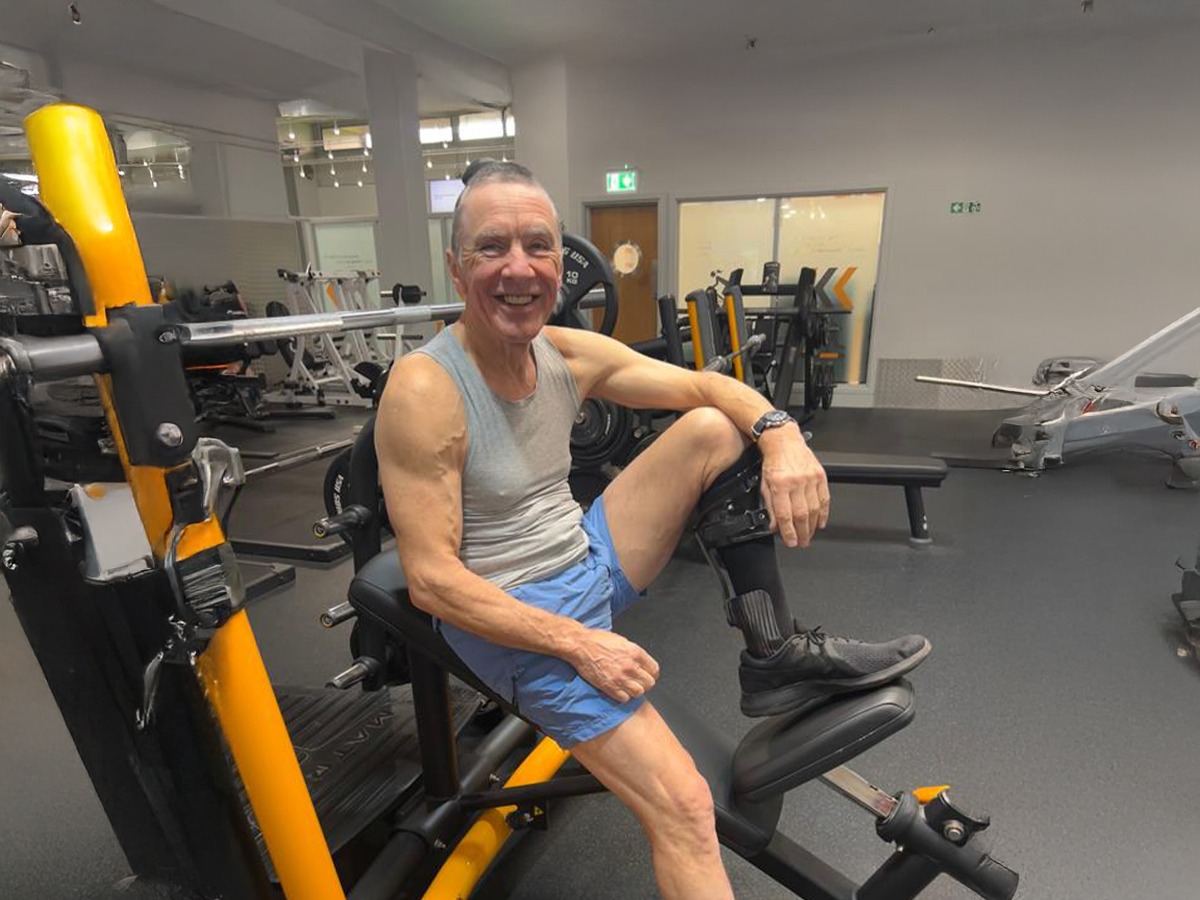
At 75, James Linford is still climbing, riding and getting stronger
On 5 December 2002, James Linford was 52 years old, living in Colchester with his wife and four daughters, and working towards one of the highest mountaineering qualifications in the UK. He had moved from nursing into youth work and outdoor pursuits instruction, gradually building experience for his Mountain Instructor Award.
That morning, he was climbing at Wintour’s Leap, a limestone cliff over the River Wye near Chepstow in south Wales.
“It was a cold damp morning,” he recalls. The group had parked at the top of the cliff but needed to descend to the base of the rock face to begin the climb. “We loaded our rucksacks with ropes and climbing kit and put on our helmets.”
The path down was wide but in places it was exposed. At points it edged along an almost vertical rock face.
“We carefully made our way along the quarried path but in a flash my foot slipped and I fell off the edge of the path.”
He had been walking behind the others. “I cried out and my friend looked around in time to see me tumbling through the air, bouncing off a rock projection and disappearing below.”
He had fallen about 50 feet.
“I landed on a small rock ledge where a small tree stopped me from going further.”
“I landed on a small rock ledge where a small tree stopped me from going further.”
He was initially unconscious. When he came round, he assessed himself quickly. “I knew my left leg was seriously damaged as I could just see that it was now a lot shorter than my other leg and it hurt like hell, my left arm was broken and I had considerable chest pain and coughing up blood.”
A cliff rescue team from the local fire service lowered him to the river’s edge before a helicopter transferred him to Frenchay Hospital in Bristol. X-rays and MRI scans revealed the extent of it.

“My left lower leg was shattered from mid Tibia down to my ankle. My left wrist was broken, my pelvis was fractured at the front, a Thoracic vertebra was cracked and I had some broken ribs.”
“Considering I had fallen about 50ft, I was lucky to be alive.”
The biggest challenge was his leg. “I was told that if this had happened a few years earlier they would have probably amputated my foot.”
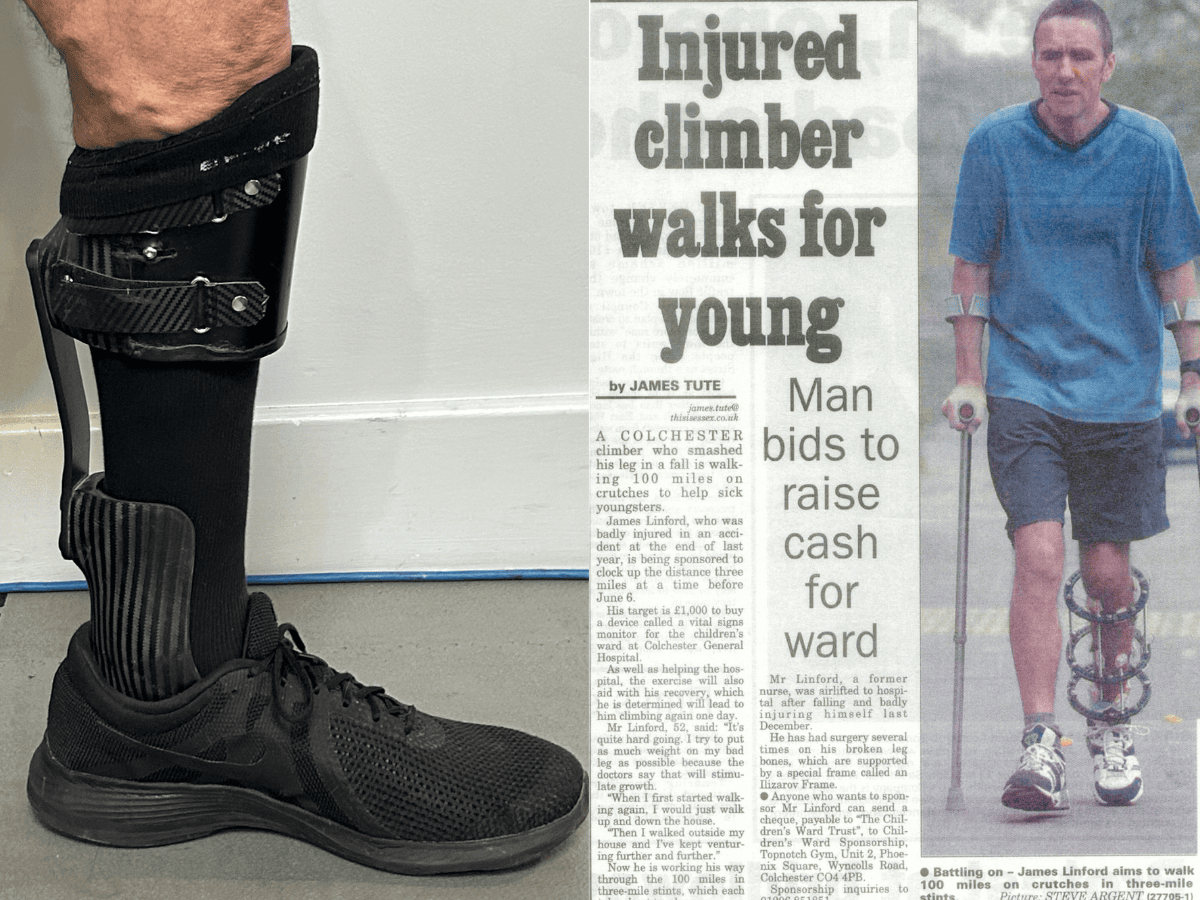
Instead, he was transferred to Bristol Royal Infirmary and fitted with an Ilizarov frame. “It was a metal cage on the outside of my leg with wires criss-crossing through the bone fragments to hold them in place while they healed.” He wore it for nine months. After one year, he was fully weight bearing.
“I’m going to climb again.”
James had always been active. Rugby and hockey at college. Cross country running. Hang gliding. Skiing in the 70s while working in a ski resort. Walking and camping in the mountains. Running an outdoor pursuits club, taking young people climbing, scrambling and kayaking.
“Suddenly, all this had to stop. I was quite incapacitated.”
At first, he accepted the stillness. “Initially I was quite happy to lay in bed and be looked after by the brilliant nurses and doctors.”
Then the pain eased. The surgeries were done. The thinking began.
“I remember the day when I was chatting to my wife as she sat by my bed. I said to her ‘I’m going to climb again.’ Too late, I realised that this was the last thing she needed to hear and she was very upset.”
For him, it mattered. “However, it was important for me to have a goal.”
So many basic tasks were suddenly difficult or impossible. “I was worried about muscle wasting but I was confident that if I did what I could I would eventually do almost everything.”
The long middle
Recovery was less about one dramatic moment and more about daily graft.
“Hard to say. There was emotional frustration at times but the toughest part was physical.”
He focused on small wins. “Celebrating small gains was helpful.” He leaned on the people around him. “I was fortunate to have a very supportive family and a good network of friends. Emotional support and encouragement was a great help.”
Did he ever feel like giving up?
“To be honest, the thought of giving up never crossed my mind.”
Once the worst pain subsided, he shifted into what he describes as a mission. “I developed a determination that I would ‘work on every front’ to be the best I could be. It was like my new ‘mission’ was to get better and recover in the best way I could.”
That mission was bigger than him. “This was not just for myself but I hoped I could be an inspiration for my children and wider family and everyone who was ‘watching.’”
Back to the mountains
He did return to mountaineering. He completed a five-day assessment in all aspects of teaching summer mountaineering and passed his MIA qualification.
When running was no longer an option, he adapted. “Because I could no longer run, I took up mountain biking and I’ve become quite proficient. It has now become my main sport or hobby.”
He has ridden in [across] Wales, Scotland and the Peak District. He has taken on the Alps. This summer, he and his mates are tackling a four-day off-road ride around the Mont Blanc mountain range on e-bikes.
At 75, he does not train every day. “It’s important to have rest days and as you get older you need more recovery time.”
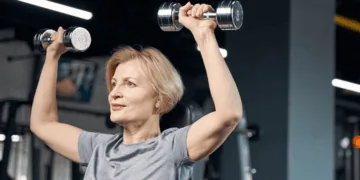
He aims for the gym three times a week for about one and a half hours. “I do mainly compound exercises to try and cover all muscle groups.” He keeps some free weights at home for the days he cannot get out. “That might not seem like much but I’m interested in efficacy and with the right program and intensity I don’t think I need many hours in the gym.”
On top of that, he rides off-road two to three times a week, usually two to three hours of fairly intense riding.
There is no age limit
“I am convinced that there is no age limit for gaining strength and mobility.”
He is realistic about the science. “It takes longer to grow muscle as you get older but it can be done.” He speaks openly about sarcopenia, the age-related muscle loss that begins in midlife. “Unless you do something to stop it you will get progressively weaker and eventually you will be frail in your old age.”
For him, strength is protective. “Frailty brings higher risk of falls and injuries whereas good musculature and mobility is not only protective but muscles play an important role in preventing some metabolic diseases.”
He also sees the emotional shift. “Being strong and having a good posture also gives you confidence and makes you more attractive.”
What gets him through the gym doors is not blind discipline. “To be disciplined in anything you have to believe that it’s worthwhile.” He tracks his lifts and his bike performance so he can see progress. He listens to inspirational speakers to stay reminded. He is also honest about fear. “I am also motivated by the fear of what will happen to me physically if I give in to a sedentary lifestyle.”
Community matters. Since training with a gym buddy, he is more consistent. He rides weekly with a club where most members are younger and fitter. “They have been happy to wait for me at the tops of hills. However, I’ve gradually got stronger and they hardly have to wait for me now.” They ride in the daytime and also ride at night, all year, in all weathers. “Being part of that social group has motivated me to do more than I ever would on my own.”

Strength looks different now
James has four grandchildren under five. “I need to be sufficiently strong and mobile to be able to pick them up, play with them, scramble around on the floor and carry them on my shoulders.”
He renovates his home. He has built a shower room and fitted a new kitchen.
“Mentally I feel better when I’ve exercised, even if I feel physically tired. I feel proud of myself and once again I feel I’m investing in my family and friends by setting a good example.”
He admits, with a smile, that he sometimes stands in front of the mirror in just shorts and says, “You’re doing alright mate.”
His background in nursing shaped his perspective. “I realised that lots of my patients were unwell because of lifestyle choices and I think that stuck with me. I want to live life to the full. To do that I need to know how to look after my body and my mind.”
He adds one more thing without hesitation. “Nutrition!! Over the last 10 yrs I have been ‘informally’ studying the subject… understanding nutrition and the ways our needs change as we get older is vital for keeping strong and healthy.”
He adds one more thing without hesitation. “Nutrition!! Over the last 10 yrs I have been ‘informally’ studying the subject… understanding nutrition and the ways our needs change as we get older is vital for keeping strong and healthy.”
When asked what being strong means now, his answer has widened.
“These days I have a more holistic view on ‘strength’ than when I was young.”
Functional physical strength still matters. Yet he sees it as part of something bigger. “The mental, physical, emotional and spiritual aspects of our being are all inter-related.”
For him, strength includes being open, learning from others, allowing trusted friends and family to speak into his life. It includes kindness. “Some people think that ‘kindness is weakness.’ On the contrary, it’s a strength when it’s used wisely.”
James Linford is 75. He lives alone since his wife died 12 years ago and has a new partner nearby. He is still riding in the dark with younger men. Still lifting. Still planning big trips.
He fell 50 feet but he decided that would not be the end of the story…